Your SQL Is Correct. Why Is Your Report Wrong?
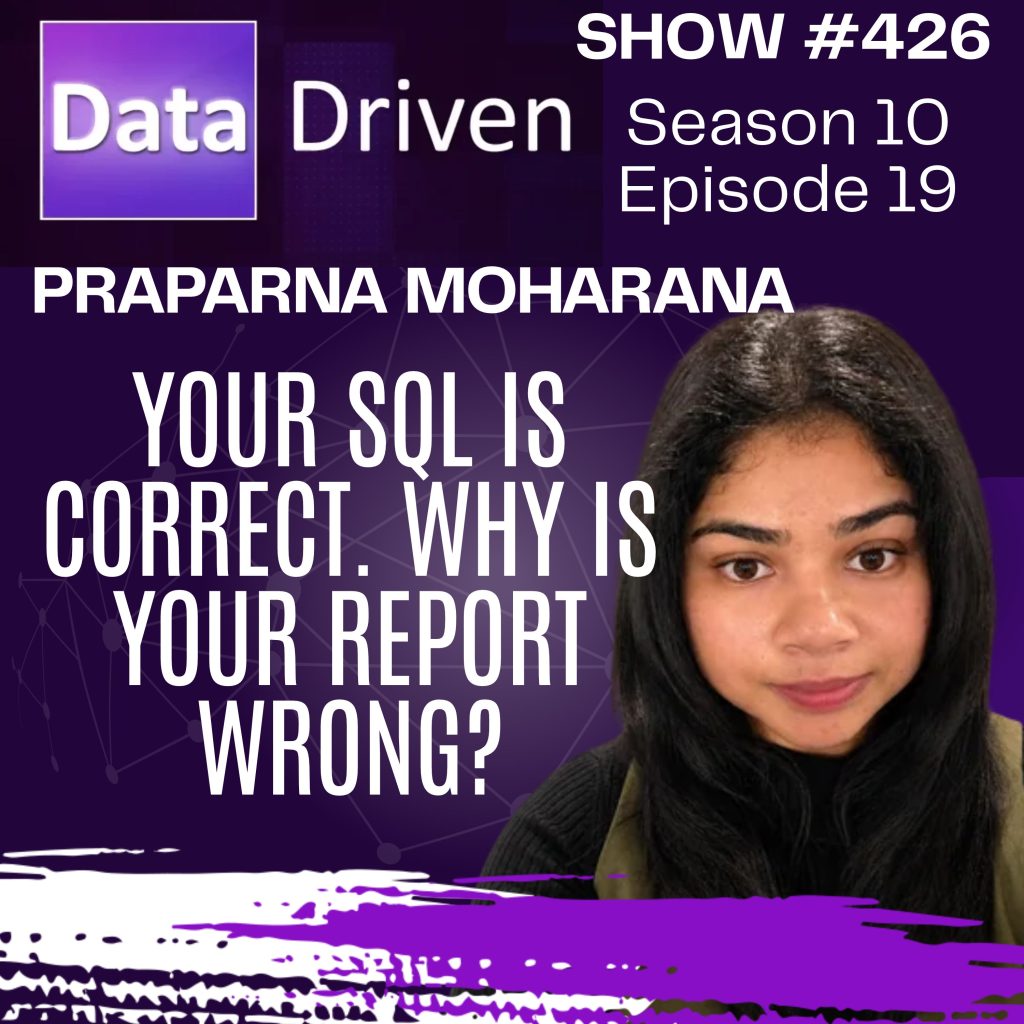
Welcome to another episode of Data Driven, the podcast where the worlds of artificial intelligence, data science, and data engineering intersect. In this episode, the conversation focused on the crucial role of data quality, automation, and reporting in healthcare analytics.
The discussion explored topics such as Electronic Visit Verification (EVV) systems, challenges and strategies in maintaining accurate and reliable data, and the balance between leveraging automation tools like Power BI, Python, and SQL with maintaining compliance and stakeholder trust. Insights were shared on practical data engineering pitfalls, troubleshooting in real-life scenarios, and advice for those starting out in the data field.
A key theme that emerged was the importance of human judgment in collaboration with technology, and the necessity of continual learning and curiosity in an ever-evolving industry. Whether you’re a seasoned data professional or just beginning your analytics journey, this episode offers practical wisdom and firsthand experiences from the front lines of data-driven decision making.
Links
- Watch on YouTube – https://www.youtube.com/watch?v=XdwFCO4EQbE
Time Stamps
00:00 Tracking and Analyzing Caregiver Timesheets
06:26 Collaborating and Automating with BI Tools
09:09 Choosing the right data tools
12:51 Ensuring Data Quality Standards
17:41 AI’s role in tech industry
19:35 Automating Data Management and Architecture
22:56 Setting business requirements for reports
28:20 Troubleshooting Power BI time zones
31:35 Troubleshooting and career growth journey
36:15 Stay curious and keep learning
37:53 Wrapping up the show
Transcript
Hey, Frank here. I just want to let everyone know real quick that I will
Speaker:be going to KubeCon this week. So if you're there, be sure to say
Speaker:hello. And if you're not there, you can live vicariously through
Speaker:me and check out the coverage that I'm going
Speaker:to do. All right. And with that, let's get on to the show.
Speaker:Well, hello and welcome back to Data Driven, the podcast where we explore the emerging
Speaker:industry of artificial intelligence, data science, and of course,
Speaker:none of this is all possible without data engineers.
Speaker:Unfortunately, my favorite data engineer in the world could not make it
Speaker:today, so I'm going solo today. And
Speaker:I am speaking today with Praparna
Speaker:Moharana, and hopefully I said that right, who is a reporting
Speaker:analyst at Tempus Unlimited, and she develops healthcare analytics
Speaker:and compliance reporting solutions She's a senior consultant at Accenture, where she develops and implements
Speaker:data solutions that transform complex operational data into
Speaker:actionable business insights. She specializes in
Speaker:SQL, Power BI, data modeling, ETL, and
Speaker:healthcare reporting with a focus on improving transparency,
Speaker:compliance monitoring, and decision-making within Medicaid and healthcare
Speaker:programs. And just because she's here doesn't mean any
Speaker:statements she makes is a— Her
Speaker:statements are not matching, may not reflect the opinions of
Speaker:her employer. Is that a good safety, uh,
Speaker:thing there? Yes. Awesome, awesome.
Speaker:So very interesting. First off, tell me
Speaker:what EVV is, because that's a new term I had not heard
Speaker:of. And, um, for those who are longtime fans of the
Speaker:show, and dare I say readers of my blog, I have a
Speaker:special place in my heart for electronic medical records. That's how I got into the
Speaker:tablet PC. platform. So what is EVV?
Speaker:So EVV stands for Electronic Visit Verification.
Speaker:So it is a technology which is used to
Speaker:track home-based care services. For
Speaker:example, if a caregiver is scheduled to visit a
Speaker:patient, so it will verify the clock-in and
Speaker:clock-out time of the caregiver and track
Speaker:Using the technology called EVV.
Speaker:Okay, interesting. So it's kind of like home healthcare visits and things like that?
Speaker:Yes. Okay. What—
Speaker:I'm unfamiliar with this, and I wonder how many of our listeners are too. What
Speaker:do you capture? And what is— why does
Speaker:getting it right matter? So mostly each
Speaker:of the patients would be provided with different kind of
Speaker:caregivers. And each day, each of the patients— and
Speaker:every day, the EVV system will be tracking the
Speaker:clock-in, clock-out of all the caregivers, and we
Speaker:collect the timesheet data. So based on that, the
Speaker:caregivers are being paid. So we are collecting
Speaker:all the timesheet data basically using all the EVV
Speaker:systems. So we need to make sure that the
Speaker:.evv systems are documenting correct reports.
Speaker:There should be no negative discrepancy during
Speaker:duration, or that we are getting the
Speaker:capture duration in a proper document manner.
Speaker:And you have to follow the sort of healthcare compliance
Speaker:requirements based on the particular
Speaker:organization. So this way, uh, we analyze the
Speaker:EDV data And document it properly and do the
Speaker:validation. Interesting. How did
Speaker:you find your way into data analytics and data engineering?
Speaker:So it is a bit of both, I would say. It's a long
Speaker:journey. I didn't plan from the beginning or think about it,
Speaker:and I'm really grateful that I came across data in
Speaker:my journey while exploring my career options. So basically it began
Speaker:from 11th and 12th grade when I had elected
Speaker:for computer science. And I have other subjects also, but
Speaker:I was so, uh, happy that like you study a small
Speaker:concept in computer science, you are done, and you just apply
Speaker:across various problem statements. It's so easy. So
Speaker:that's why I did my undergrad in computer
Speaker:science. But in computer science, I was a little
Speaker:bit overwhelmed because of exploring different
Speaker:areas of computer science and different
Speaker:programming languages and web applications, I would
Speaker:overrun. But later I was quite determined I
Speaker:will go for a higher level degree. And during my gap
Speaker:year, COVID happened, and during my gap year I took data science
Speaker:course and I learned
Speaker:about exploratory data analysis, data quality,
Speaker:data cleaning. Machine learning methods I
Speaker:learned. I, and I was really interested in,
Speaker:uh, that, and it, and it, uh, applies, um, naturally
Speaker:with my instincts because I am good in observing and noticing
Speaker:things. So I was really find it very
Speaker:fascinating. So instead, when I saw my curriculum
Speaker:for master's in computer science, I didn't saw any data
Speaker:analysis or data science course. I thought it's better
Speaker:to switch for master's in data analytics previously,
Speaker:and that way data found me and I found
Speaker:data. It's a mutual relationship and it started.
Speaker:That's cool. Like, that's the question I always like to ask is like, did you
Speaker:find data or did data find you? And it sounds like
Speaker:it was a match made in heaven, I suppose, because you— yeah, no.
Speaker:And data can be very— from the first glance of it, for me, it wasn't
Speaker:love at first sight. It was kind of like, It
Speaker:was kind of like, I kind of saw it again in a fresh light.
Speaker:And I realized like, there's a really good
Speaker:engineering discipline behind this. And there's so many
Speaker:problems you can solve with advanced analytics and things like that.
Speaker:So my notes say that you do independent research. What, what questions are
Speaker:you— what are you exploring in your independent research? So mostly in
Speaker:my independent research, I mostly deal
Speaker:with collaborating with other industrial people. For
Speaker:example, I collaborated in how to build
Speaker:and like whether it is beneficial to
Speaker:go for to discuss in our research and help people
Speaker:across industries in topics like it is, is
Speaker:it better to build an in-house BI tools in place
Speaker:of vendor-based. We discussed that in our
Speaker:collaboration and when to go for
Speaker:in-house BI development and what kind of
Speaker:customization you can have with in-house BI
Speaker:developments and what kind of— for example, I've got
Speaker:someone who is, who has knowledge of Salesforce,
Speaker:somehow who has knowledge of AI intelligence, and we would
Speaker:collaborate that how with integration of
Speaker:Salesforce and the data architecture knowledge I
Speaker:have, we can collaborate and make the architecture and
Speaker:people can use that architecture and
Speaker:Salesforce collaboration across industries and
Speaker:AI intelligence tools. So this way we try
Speaker:to help, like even in my speaking opportunities, I
Speaker:extensively talked about how we can
Speaker:automate like all the reports using tools like
Speaker:SQL, Python, and Power BI,
Speaker:and why it is taking exact various
Speaker:examples. For example, healthcare compliance, for
Speaker:example, and how to handle voluminous
Speaker:amount of data, why it is really important to have an end-to-end
Speaker:architecture, and based on your data source, what
Speaker:kind of tools you have to decide. For
Speaker:example, if you are collecting data
Speaker:from API calls, why it's better to choose
Speaker:Python if you have diverse data source, because it
Speaker:would provide a large source of diversity and flexibility
Speaker:while doing data monitoring or data log, like
Speaker:detecting the errors in the pipeline. It will be
Speaker:easier, and even API validation, authentication,
Speaker:tokenization. If you choose Python and if you have 2
Speaker:databases, it's best to go with linked servers and
Speaker:open queries because if you use Python for that, what happens
Speaker:if you have 2 open cursors from different databases?
Speaker:If cursor 1 is running a select statement,
Speaker:so what happens? The cursor 2 open, so
Speaker:it— meanwhile the cursor 1 is executing the
Speaker:query, the cursor 2 is dead. And because of that, you
Speaker:would have data latency issues
Speaker:and you won't get timely reports. So it's better to
Speaker:go with SQL Server. So you have to be smart around
Speaker:deciding the tools, whether you should go with Python or
Speaker:SQL. And because mostly I talk about data
Speaker:automation, means automation of
Speaker:reports which are manually generated into Excel,
Speaker:So whenever people think about reports, they mostly
Speaker:go around a basic idea or think about in generalized way
Speaker:about dashboards, summary reports, charts, but it is
Speaker:not about that. It's entire lifecycle of data from
Speaker:data extraction, making of reports, applying, knowing the
Speaker:business rules the stakeholders want,
Speaker:and providing reports to using Power BI, and
Speaker:even you can even automate reports further using
Speaker:Power BI if the stakeholders need email
Speaker:like more than 8 refreshes in Power BI
Speaker:overnight. Like Power BI can do 8 refreshes, but if
Speaker:you want more than 8 refreshes, you should use Power
Speaker:Automate or various things. If you want to split the file
Speaker:into various categories and you can't provide
Speaker:like Power BI Pro licenses, licenses to
Speaker:various users, you can sure put that in a
Speaker:SharePoint, pen drive, or OneDrive, whatever you use, and
Speaker:the Power Automate can split it. And even you can email it.
Speaker:So Power Automate can further automate the work which we
Speaker:manually do in Excel, like splitting of files
Speaker:or like emailing the report. So
Speaker:mostly I am more interested to the automation parts of
Speaker:reporting and Making things easier.
Speaker:Interesting. And when you say cursor, you don't— because we live in the AI
Speaker:age that's dominated by AI tools, you don't mean cursor the
Speaker:AI tool, you mean the cursor of the old-school SQL
Speaker:process, right? Mostly it is
Speaker:being processed sequentially, so it's better to go
Speaker:with— but I won't say because of AI, because many
Speaker:organizations still refrain from using AI because of
Speaker:high sensitivity and confidential data. refrain from using
Speaker:AI tools and really against Copilots, and,
Speaker:uh, they totally don't use that. So the thing is, I was
Speaker:talking about cursors because in Python we sequentially
Speaker:would be running a line of code. So it's better if
Speaker:we use open query, it won't run sequentially. Like both, we would have,
Speaker:uh, both the active connection. In cursors, one cursor
Speaker:is running, so other cursor would be dead when
Speaker:first cursor is running. That That's the issue I
Speaker:had faced while troubleshooting a lot, which I
Speaker:discovered from my own when I used 2. Yeah, no one—
Speaker:every time I mentioned doing a— using a
Speaker:cursor, they always— everyone's told me do
Speaker:something else, right? It's really, you know,
Speaker:I think I've only ever used it professionally twice in my
Speaker:career. And once I got yelled at for
Speaker:doing it, and then the other time was someone who was far
Speaker:more experienced than me said, no, that really is the only use
Speaker:case. Like, that really was the only solution. So I think that's— it's
Speaker:very telling kind of how that worked out. But
Speaker:in practical terms, what does good data
Speaker:quality look like?
Speaker:So mostly good data quality will look like
Speaker:that each— if you look at a single
Speaker:record in your database, it would have all the
Speaker:accurate, no missing values in a single record,
Speaker:and there wouldn't be any kind of
Speaker:data discrepancy like negative, for example,
Speaker:duration is negative 15 minutes, you need to validate the
Speaker:data. So I would I would say missing— no
Speaker:missing values. All the fields should have values in structured data.
Speaker:And I would say that's the most important part of data
Speaker:quality. And when you go through the
Speaker:entire lifecycle of data, there should be no duplicate records.
Speaker:You should have each unique record.
Speaker:That's the most important thing about data quality,
Speaker:I would say. And like while building architecture,
Speaker:like the entire lifecycle I was talking about, when you pull data from the raw
Speaker:source, you're moving from SQL layer to Python
Speaker:layer to the reporting layer like Power BI. You have to
Speaker:see that the data which you have collected, if
Speaker:it is 1,000 rows, it should be
Speaker:1,000 rows till the end of the reporting
Speaker:when you reporting layer, taking into
Speaker:consideration how you validate the record.
Speaker:Why do teams struggle so often with data quality? Because data quality
Speaker:has been a problem that since I
Speaker:was a young man, I had way less gray hair, had been an issue. It's
Speaker:like, so why are we struggling with it still?
Speaker:I remember when the discussion was,
Speaker:Does data quality matter? Clearly it does, and I think
Speaker:we found out the hard way that it does. But why is this so hard
Speaker:to not have missing values and things like that? What
Speaker:is it, industry use case specific? What's your thoughts on that?
Speaker:For me, it depends how we— how the source is collecting the
Speaker:data, right? Uh, maybe we could have
Speaker:inaccurate time zones. Because the, for
Speaker:example, system would be in a different time zone in UTC and we
Speaker:are, we want in EST time zone where we are.
Speaker:So mostly time zone issues and
Speaker:it could be like we would have negative,
Speaker:like missing values as I mentioned earlier, and
Speaker:we need values in standardized date format. We
Speaker:would always face issues because we are trying to collect data from
Speaker:different sources, not from a single
Speaker:centralized unit. And we are trying to
Speaker:gather information to get an
Speaker:answer to a single question which we
Speaker:want, as the stakeholder
Speaker:wants. I think mostly because we are
Speaker:trying to collect it from different systems. From one would be coming from
Speaker:API call, one would be coming from a different
Speaker:database system. So mostly because of different systems, we
Speaker:would always face data quality issues. You
Speaker:are on mute. I'm sorry.
Speaker:Do you think AI can help with data quality issues?
Speaker:Yes, they can help with data quality issues.
Speaker:But as far as I'm aware, I'm reading through
Speaker:other people's experience, and from what
Speaker:I've read about AI is that when you try to
Speaker:solve something complex, problem, it's really
Speaker:difficult for AI to keep track of the data
Speaker:quality and what we want. So
Speaker:we really need the human judgment to ensure that
Speaker:what kind of standardization and normalization we need to
Speaker:apply to our data for improving the data
Speaker:quality. We can take help of AI to
Speaker:improve the process or take suggestion, but it
Speaker:can't hopefully help with automating the data quality,
Speaker:like, by any human
Speaker:interaction or human reviewing it manually.
Speaker:Interesting.
Speaker:What's your take on the use of AI in
Speaker:data systems, like, in the data engineering space? Is that—
Speaker:I think data engineers have a pretty bright
Speaker:future in terms of career-wise, but
Speaker:how do you think the rise of AI agents are gonna
Speaker:impact people's careers?
Speaker:Um, it would— it wouldn't—
Speaker:I think from my point of view, it can't replace—
Speaker:like, it is mostly said that AI will replace
Speaker:human jobs. But I feel it
Speaker:won't actually completely replace. It could
Speaker:make data engineers' life easier
Speaker:because in certain directions
Speaker:we could use agentic AIs and AI
Speaker:prompts, or to make our— to
Speaker:make— to get suggestions how to make process easier.
Speaker:But because industries want to maintain the
Speaker:confidentiality and maintain AI governance,
Speaker:so mostly AI won't affect that
Speaker:much. What I have seen, because mostly
Speaker:I have seen organizations who are in
Speaker:healthcare industries, they refrain from
Speaker:using AIs. So It
Speaker:really, like, I know AI can help you to
Speaker:optimize SQL queries, AI can help you
Speaker:build metadata and ETL pipelines and suggest a better
Speaker:architecture, but there is still a
Speaker:lot of issues with AI governance and data
Speaker:issues with the confidential and sensitive data which
Speaker:organizations own. That's a great
Speaker:segue because we talked about AI, we talked about that, but what
Speaker:parts of— how do you decide which parts of an ETL
Speaker:or ELT workflow are worth automating first?
Speaker:Like, how do you— is it about how often the job has to run?
Speaker:Is it about criticality? Is it something else, some mixture
Speaker:of the above? So mostly the most
Speaker:repetitive task which we perform should be
Speaker:automated using the tools we want.
Speaker:For example, every time transport— I would
Speaker:say, uh, whatever reports we need to
Speaker:generate, we first need to understand
Speaker:first the business requirements of the stakeholders,
Speaker:because, and because it is, every
Speaker:organization would have different business rules, and it becomes quite
Speaker:difficult for us to understand which
Speaker:records we should include, exclude while building a
Speaker:metric. So mostly, first is the
Speaker:business definition and the requirements of
Speaker:stakeholders, and secondly, on the
Speaker:base voluminous amount of data being generated, so you
Speaker:have to come with efficient design of a data architecture
Speaker:such that the data is maintainable and
Speaker:recoverable. For example, if the one of the data
Speaker:pipelines fails and you, you
Speaker:won't get the report being loaded in the table which
Speaker:we require for the reporting, it's better to show the
Speaker:last refresh historical data to the
Speaker:stakeholders instead of showing no data because
Speaker:the data failed, so you can gain
Speaker:stakeholders' trust. And most importantly, it
Speaker:is important to maintain a control log,
Speaker:like when the data is inserted or deleted,
Speaker:in what amount of duration data is getting inserted, and how
Speaker:many records were inserted in the database. So
Speaker:this is— and you even have to see that if there is any
Speaker:failure in the system, You have to monitor when you rerun the
Speaker:data pipeline, you have to see the last
Speaker:log point, like last timestamp when it
Speaker:did stop running, and you have to— when
Speaker:you start try to rerun the data, you have to see there is no kind
Speaker:of duplication happening in the data. So you have to
Speaker:maintain the idempotency of the data, so we
Speaker:don't have duplicate records while rerunning the data.
Speaker:And mostly, so this
Speaker:way, uh, you have to, you have to even
Speaker:maintain the valid or invalid record
Speaker:history because in future if business requirements change,
Speaker:it is really important to know, figure
Speaker:out in the data that what is,
Speaker:it is really important about what kind of data records are getting affected.
Speaker:Right. It's just interesting. Obviously, reports
Speaker:have to be reliable and accurate.
Speaker:What do you— how do you
Speaker:balance moving quickly with reliable reports?
Speaker:It seems like, you know, the old, you can't have it good— you can have
Speaker:it good, fast, or cheap, and you have to pick 2. Right.
Speaker:What's your take on that?
Speaker:For having reliable reports, first I would say
Speaker:I will provide an example. For example, I'm trying to
Speaker:calculate the percentage of
Speaker:completion rate of a visit. I will take the
Speaker:completion rate and a denominator as the total number of
Speaker:visits. So I don't know in total number of
Speaker:visits whether should I consider the invalid records
Speaker:and incomplete records of visits which were never done.
Speaker:So it is something which could be defined by a
Speaker:business. So we need to have the answers
Speaker:documented from the stakeholders, what kind of— what
Speaker:we need to include in the total visit denominator so we
Speaker:can get accurate number
Speaker:in our Percentage of completion rate.
Speaker:So this way we could have a reliable report which could
Speaker:show us accurate values, because
Speaker:sometimes the— our report to be technically correct, we
Speaker:have built a good SQL, we are doing the good
Speaker:data source extraction and
Speaker:validation and maintaining all the control logs,
Speaker:but Still technically the process is correct, but
Speaker:our reports will still be showing inaccurate values.
Speaker:So it is really important to have clear
Speaker:business requirements set. And secondly, you should have—
Speaker:you need to build the stakeholder trust by showing the
Speaker:last refresh rate in your reports. So
Speaker:it is a— this is where you can help their health building
Speaker:a reliable report. So it is
Speaker:like they can see the last refresh date, date, and if
Speaker:it is, it is past midnight and today it is
Speaker:daytime because the pipeline failed, but
Speaker:they would be like, yes, we have accurate data for which
Speaker:we want to make the decision. So this way we could make
Speaker:reliable reports. Taken
Speaker:into consideration these practices.
Speaker:Interesting. I often find
Speaker:it fascinating that
Speaker:people think that AI can do all the— all sorts of things, and
Speaker:I think ultimately human judgment, and people rely on these
Speaker:reports, right? Data engineers, data types,
Speaker:so to speak. When I was doing consulting
Speaker:back in the day, people hated doing reports,
Speaker:right? Probably because Crystal Reports was this awful software. And
Speaker:if you've never heard of it, you're very thankful to be born when you were.
Speaker:But I remember just having to work with it.
Speaker:Again, it wasn't really a fun experience, but the fact
Speaker:that it was able to— the fact that you
Speaker:You could. What really matters with reports is
Speaker:reports are what people who write the checks see,
Speaker:right? Whether that's a KPI dashboard or anything like that, the people who
Speaker:are the business users are the ones that see the reports.
Speaker:And that is crucial in
Speaker:business decisions are made. And plus they're also the people signing the checks usually.
Speaker:So if you keep them happy, that that's good for your
Speaker:budget. What would be your advice to someone starting out? If you
Speaker:had to go back and tell, you know, your 11th, 12th
Speaker:year student, what would you say to yourself or someone
Speaker:else in that similar position? I would say
Speaker:first to believe in yourself, because when I
Speaker:was doing my master's, I was quite keen
Speaker:that I would get an internship. To get
Speaker:real hands-on experience before moving
Speaker:into a full-time opportunity after my
Speaker:graduation. So when I did my
Speaker:internship at a manufacturing company,
Speaker:for— at Balmain Richardson Foods, so
Speaker:mostly I was— my work was to
Speaker:automate Power BI reports for the manufacturing
Speaker:flow. So
Speaker:mostly I would say that I
Speaker:was doing a lot of things out of the blue, like from
Speaker:a beginner Power BI knowledge and foundational knowledge,
Speaker:I was jumped into for advanced Power BI
Speaker:things and real-life problem requirements. For
Speaker:example, I need the data was
Speaker:imported into Power BI using API calls.
Speaker:So it does not like that if you are using any other data
Speaker:source, it would collect that time zone. Because of the API calls,
Speaker:it was collecting a different time zone, the
Speaker:default UTC. And in manufacturing, you
Speaker:need the data to be visible to the operators and the
Speaker:supervisors, which is 24/7, and the data should be visible
Speaker:at midnight also. So out of the blue,
Speaker:the report was blank and there was nothing showing
Speaker:up in the Power BI report. Wow. So it was kind
Speaker:of— yeah, so it was like,
Speaker:I'm doing everything right, I'm not doing— I'm doing— not
Speaker:applying any kind of formula on the time zone, what's
Speaker:happening? And later I figured out that it
Speaker:is because Power BI defaults to UTC time zone and you
Speaker:don't have any settings in Power BI So you can change the time
Speaker:zone. So I have to develop
Speaker:that formula to change from UTC to
Speaker:EST or EDT time zone. So because of
Speaker:daylight savings, it was a bit difficult. And you have to
Speaker:work and you can't find a solution anywhere on the internet
Speaker:and you have to use your own knowledge to come up with the
Speaker:idea. So it was a big troubleshooting
Speaker:ability I gained in my internship. And secondly,
Speaker:I need to— like, most of the reports need to be deployed
Speaker:on it. Some of the reports need to deploy on TV so the
Speaker:workers on the floor can
Speaker:see the TV, what the Power BI reports, and know
Speaker:the required business, what is happening. But like, they could
Speaker:know about downtime of a machine, or they could know
Speaker:about overall hourly
Speaker:performance of what is happening in the
Speaker:manufacturing flow. So when the
Speaker:report is deployed on TV, you can't have user interaction.
Speaker:And I was like, the challenge was like how to
Speaker:make the Power BI refresh every—
Speaker:to refresh every 5 or 10 minutes or 15
Speaker:minutes without any user interaction. So it
Speaker:was a challenge for me too, because if you
Speaker:notice, when a Power BI report refreshes, there
Speaker:would be any kind of human interaction, or you would
Speaker:refresh the browser. So that was a major challenge,
Speaker:and I have to come up with some unique solution from my own way.
Speaker:Yeah, interesting.
Speaker:There's just no substitute for doing to learn, is there?
Speaker:No, those horrible experiences
Speaker:tend to stick with you and you learn the most from. I haven't
Speaker:figured out a way to learn with, uh, and still avoid them.
Speaker:If anyone else, you know, who's listening to this has found that, I would love
Speaker:to know about it. Audible is a sponsor. Do you listen to audiobooks
Speaker:or— Oh yes, I do
Speaker:listen to audiobooks. Any recommendations for our audience?
Speaker:I would say Storytelling with Data
Speaker:by Paul Nuttlick. Okay.
Speaker:Interesting. Very cool. Audible is a sponsor of Data Driven,
Speaker:and you can get yourself a free book if you're listening and you go to
Speaker:thedatadrivenbook.com. That routes you to Audible and you'll get a free audiobook
Speaker:on us, and we get a little tap on the shoulder that'll probably be enough
Speaker:to buy a cup of coffee. Maybe not, depending if it's Starbucks or
Speaker:gas station coffee. What's your favorite part of your current gig?
Speaker:My favorite part is when I have already built
Speaker:existing projects which are already deployed,
Speaker:and when somebody comes out, there is an error or there's
Speaker:some issue, I don't know, I enjoy to notice
Speaker:the discrepancy and Troubleshoot
Speaker:the issues. So that's my favorite
Speaker:part of gig. And the challenges I, I told you
Speaker:which I faced during my internship for the things
Speaker:which are out of the box and you can't find a solution anywhere
Speaker:on the internet, uh, that's nice.
Speaker:And I really like— I learned a lot of things from my job because
Speaker:First, I was a data analyst, and from
Speaker:beginner I jumped to advanced because of the
Speaker:things which were— because of the requirements which were given to me.
Speaker:And then later I became a data engineer in my
Speaker:job, so I learned various things— how
Speaker:to do link server and how to
Speaker:interact with multiple databases.
Speaker:And how to use OpenQuery, how to build
Speaker:effective data architecture based on a volume of data, how to
Speaker:manage 100 million amount of records. And
Speaker:because in Power BI you can't import 100
Speaker:million number of rows, you need to optimize before importing
Speaker:the data in Power BI. So you have to be creative
Speaker:around getting a good data architecture
Speaker:and streamline the process.
Speaker:So that's my favorite part of the work I do,
Speaker:what I learn every day in my job. Very cool.
Speaker:What do you think the coolest thing in technology is today?
Speaker:For me, I know many people would say AI,
Speaker:but I was working in a health industry You
Speaker:help mostly organization refrain from using AI
Speaker:for the sensitivity and confidential data. So for me,
Speaker:automating the reports using Power BI,
Speaker:Python, and SQL is the most interesting
Speaker:part in the technology than AI. I can just
Speaker:get— use AI prompts to get suggestions how to make
Speaker:the system more effective and how to make
Speaker:each of the reporting
Speaker:lifecycle of data easier.
Speaker:But I would say reporting
Speaker:automation is the most— using SQL,
Speaker:Power BI, and Python is the
Speaker:most— is the thing that fascinates me in the technology.
Speaker:Interesting. What are you looking forward to technology doing one day?
Speaker:So I, I look
Speaker:forward that we don't have to do repetitive
Speaker:tasks and have all the
Speaker:reports automated and just work
Speaker:on the maintenance of the reports rather than
Speaker:still a lot of— I see a lot of
Speaker:reports are being generated and people being very
Speaker:like, they are very, uh, like used to, or like for
Speaker:example, when I was doing reporting automation in
Speaker:manufacturing for manufacturing flow, though the reports
Speaker:were automated, people were still using paper timesheets
Speaker:to validate it. They didn't rely on it. So
Speaker:I would say mostly
Speaker:build a more reliable reporting automation
Speaker:where people can trust. Interesting.
Speaker:Where can folks find out more about you and what you're
Speaker:up to? People can find more about
Speaker:me on LinkedIn. So you can see
Speaker:articles written by me and the
Speaker:podcast I participated in, and
Speaker:the— in the roundups I
Speaker:participated in. And you can
Speaker:know more, you can get the articles and roundups and the
Speaker:opportunities I go for and learn
Speaker:more about me mostly through LinkedIn.
Speaker:Interesting. Very cool. Any parting thoughts?
Speaker:What do you say? So any, any final thoughts that you'd like to share with
Speaker:the audience? The final thought I would share
Speaker:with the audience is that stay curious and
Speaker:don't stop learning. And if you want to learn something,
Speaker:try to, try to participate in, uh, if
Speaker:you're a beginner, try to participate in hackathon because it
Speaker:could change the way you look at things and you will
Speaker:network with fascinating people early in your
Speaker:career. And if you are a beginner, definitely
Speaker:go for internship because during internships employers are a
Speaker:bit lenient and they just want to know how
Speaker:excited and what— you have good amount of knowledge
Speaker:before applying the hands-on skills. But if you are going for a
Speaker:full-time opportunity, it becomes really important that
Speaker:you have close industry experience because people don't want to train
Speaker:you. So always keep learning. And while, uh, in my
Speaker:job mostly I learned a lot of things. And when
Speaker:you look at a legacy architecture or listen
Speaker:to people who are already in the industry,
Speaker:you— in— when I go for my speaking opportunities, you
Speaker:come up with different solutions. It is not that only that
Speaker:non-STEM people only have to come with creative
Speaker:ideas. STEM people even have to be
Speaker:creative with their problems which we are trying to solve. And it's
Speaker:quite fascinating to see that even
Speaker:in STEM, each problem would have different solution
Speaker:and effective way in doing it. So always
Speaker:try to learn and be curious. Very cool. What a great
Speaker:note to end on. Thanks for joining. Thanks for being on the show. We'd love
Speaker:to have you back again. You can Go really deep into the nerdy
Speaker:Power BI and SQL Server stuff with Andy. And for this, we'll let the
Speaker:credits roll. Awesome. Thank you very much.

About the author, Frank
Frank La Vigne is a software engineer and UX geek who saw the light about Data Science at an internal Microsoft Data Science Summit in 2016. Now, he wants to share his passion for the Data Arts with the world.
He blogs regularly at FranksWorld.com and has a YouTube channel called Frank's World TV. (www.FranksWorld.TV). Frank has extensive experience in web and application development. He is also an expert in mobile and tablet engineering. You can find him on Twitter at @tableteer.