Exploring the Collision of AI and DevOps Worlds at KubeCon North America Day Zero
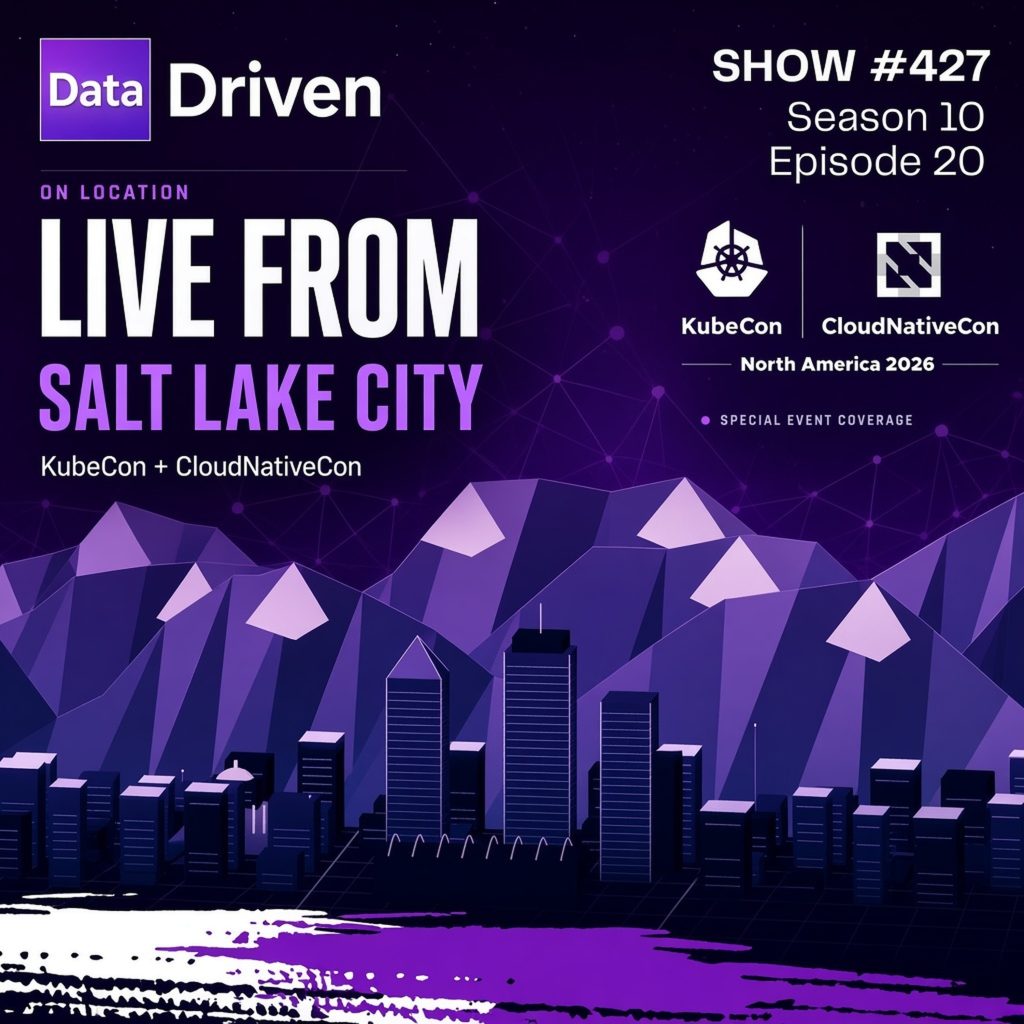
Welcome to a special episode of Data Driven, coming to you from day zero of KubeCon North America 2026 in Salt Lake City.
The conversation focused on the evolving intersection between data, AI, and DevOps, with particular attention to the role of Kubernetes and its growing impact on both worlds. A key theme that emerged was the surprising disconnect between traditional data professionals and Kubernetes, even as the technology increasingly underpins cloud data services and AI workloads. The discussion explored how the convergence of DevOps and AI is forcing a new kind of collaboration, raising questions about tooling, infrastructure, and the right skill sets for future enterprise AI platforms.
Several points were raised, including the challenges of managing token costs, the need for scalable data solutions, and the importance of creating safe, productive spaces for both infrastructure admins and AI builders. Join us as we dive into the observations and trends shaping the future of data and AI at this year’s KubeCon.
Links
- Watch the original live stream – https://www.youtube.com/watch?v=G2tZDGLw23o
Transcript
Hello and welcome to Data Driven, depending on how
Speaker:you're consuming this. My name's Frank Limogno. You can catch me at Frank Digs Data
Speaker:on most of the socials and franksworld.com,
Speaker:datadriven.tv, and of course impactquantum.com. And
Speaker:today was day zero, I guess, of
Speaker:KubeCon North America:Speaker:City, which is really nice fall weather, honestly, right now. Got my
Speaker:badge. Qlik is a sponsor. So shout out to
Speaker:my peeps at Qlik. I got a chance to walk through the expo
Speaker:floor as folks were setting up and I noticed a very consistent
Speaker:theme. And that theme is that a couple of things.
Speaker:One, most data people really
Speaker:don't interact with Kubernetes. And let me explain.
Speaker:My brother from another mother, you know him as the co-host of Data Driven. He,
Speaker:he's a, you know, he is the SQL Server genius. Yes.
Speaker:And he's never really worked with Kubernetes. And I asked him, I was like, has
Speaker:it come up at all in your, in your
Speaker:career, your consulting or whatever? Has Kubernetes come up at all? And
Speaker:apparently no, it has not. Which I find very intriguing
Speaker:that somebody like Andy, who is, you know, definitely the
Speaker:SSIS guru, SQL Server data warehousing guy, hasn't really
Speaker:touched Kubernetes. AI people, of which I
Speaker:am. I never really had to deal with Kubernetes. Actually, it wasn't until I
Speaker:really appreciated, with the Red Hat, that I appreciated Kubernetes at all.
Speaker:Even though realistically there's probably some form of Kubernetes underneath
Speaker:Azure, all the Azure data services, which got me thinking
Speaker:about how the data world
Speaker:is going to interact with the
Speaker:DevOps world in the future. For the majority of
Speaker:its life, Kubernetes was really about DevOps, right? Delivering services at
Speaker:scale. Well, what's going to happen when those
Speaker:services that are going to be delivered at scale are going to be AI, AI
Speaker:inference, right? That those 2 worlds are colliding.
Speaker:That was really kind of the theme I saw. I saw a number of other
Speaker:advertisements and kind of as people were setting up the booths, I always like to
Speaker:check out the competition. Another theme was
Speaker:their data, serve data through Kubernetes, serve whatever. And
Speaker:another theme was token costs, right? Managing your token costs.
Speaker:And basically token spend and things like that. So I
Speaker:think it's interesting to see how
Speaker:the DevOps world and the
Speaker:AI world are forcing this conversation together. I don't know if the data
Speaker:world is going to have this, although I did see a number of Postgres scaling
Speaker:up on Kubernetes and there was another data platform too. So I find
Speaker:that interesting that we're seeing kind of the Kubernetes world and the AI world
Speaker:kind of merged. I saw this coming at Red Hat, but I
Speaker:think the challenge is, and again, this is a plug for my
Speaker:employer, the challenge is, do you really want your data scientists
Speaker:messing around with your Kubernetes infrastructure? The
Speaker:key thing to keep in mind here isn't so much
Speaker:the infrastructure. I think people get wrapped around the axle about the infrastructure,
Speaker:right? And it's not infrastructure for infrastructure's sake. You want to get these
Speaker:POCs and you want to get them out to production, right? And I think that's
Speaker:really where the rubber of the— is going to meet the road, needs to meet
Speaker:the road over the next couple of years in terms of seeing what a good
Speaker:return on investment is for AI, because that's also going to be a hot topic
Speaker:in the not too distant future. So I think that what
Speaker:gets me excited about working at Qlik is that I think we have that answer.
Speaker:We call it the control plane for enterprise AI. Stop by booth
Speaker:276, I believe. I saw the Qlik demo, I saw
Speaker:ClearML, I saw what they were working with Qlik, and I was like, this is
Speaker:it. This is the answer. Because you want to have the space for your
Speaker:infrastructure, your admins. You want to have a safe place for the
Speaker:AI builders to make, right? The data scientists, the AI engineers. And you
Speaker:want to have a place where you can have people are using the apps that
Speaker:the builders use, right? So you really have that 3 layers of
Speaker:use cases. And I'm seeing a few other Kubernetes platforms
Speaker:and they force AI engineers to learn
Speaker:Kubernetes, which will they learn it? Maybe,
Speaker:but realistically they shouldn't have to do it. And I wouldn't
Speaker:trust your average data engineer. Sorry, Andy. Although you're well
Speaker:above average data engineer, Andy, with anything that is related
Speaker:to, to managing Kubernetes at all, because it's a very different
Speaker:skillset and it is a different world. It's a different mind
Speaker:space. There's different concerns. But we all have to work together
Speaker:to make enterprise AI work. I do have some footage I took with the
Speaker:Osmo, and I'm hoping to edit that down tonight
Speaker:and get an early start tomorrow because we're going to have fun, fun,
Speaker:fun. So far, I've been very excited about, about KubeCon.
Speaker:So with that, I'm going to end the stream.

About the author, Frank
Frank La Vigne is a software engineer and UX geek who saw the light about Data Science at an internal Microsoft Data Science Summit in 2016. Now, he wants to share his passion for the Data Arts with the world.
He blogs regularly at FranksWorld.com and has a YouTube channel called Frank's World TV. (www.FranksWorld.TV). Frank has extensive experience in web and application development. He is also an expert in mobile and tablet engineering. You can find him on Twitter at @tableteer.