The Collision of AI, Data, and DevOps: Insights from KubeCon 2026
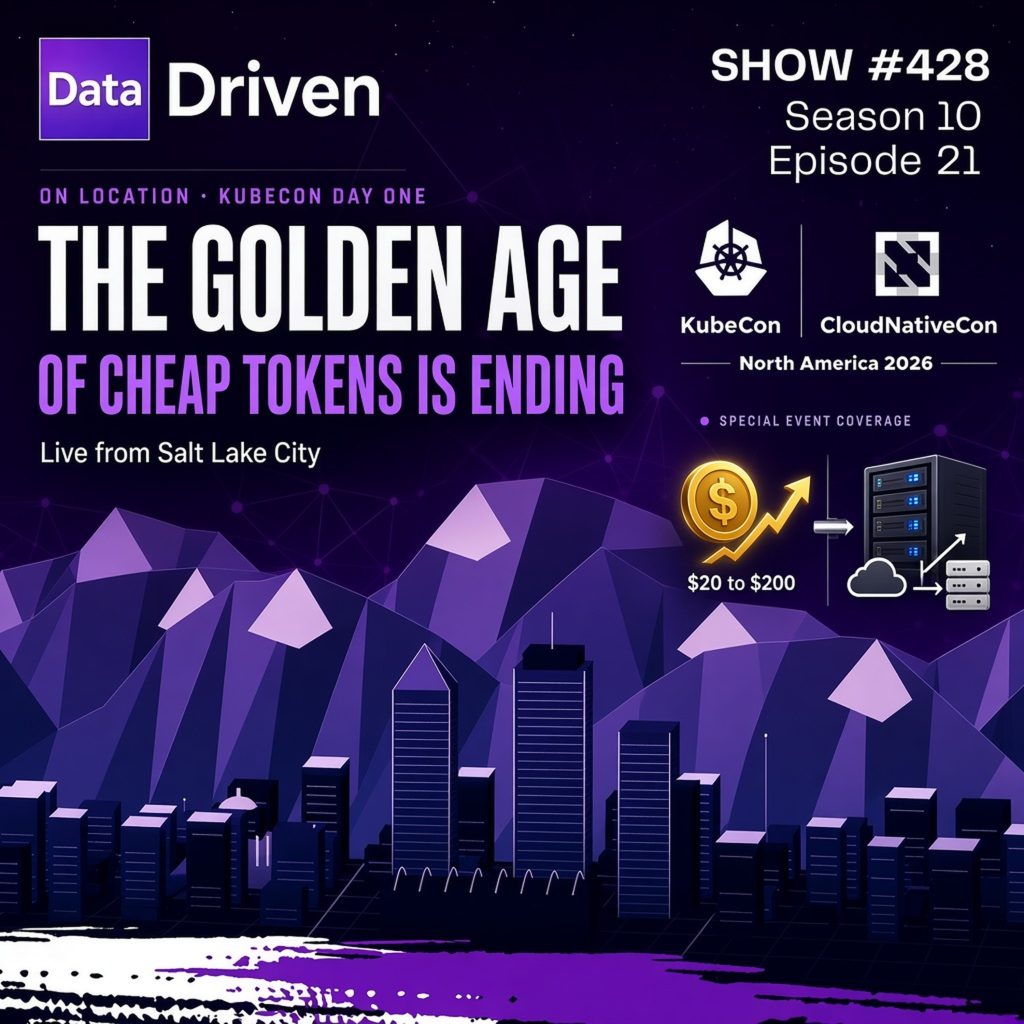
Welcome to Data Driven, where this week’s episode comes to you live from KubeCon 2026. The conversation focused on the emerging intersection of artificial intelligence, data, and DevOps, highlighting how Kubernetes is poised to play a pivotal role in advancing AI innovation. A key theme that emerged was the rise of tokenomics and the shifting economics of AI, particularly as organizations balance cloud and on-premise solutions in pursuit of cost control and privacy. The discussion explored the growing need for collaboration between IT admins, AI builders, and data scientists, and introduced new strategies for managing AI infrastructure in a rapidly evolving hybrid world. Tune in for insights into the future of AI deployment—and what it means for your career.
Transcript
Hello and welcome back to Data Driven. This week, Frank is at KubeCon
Speaker:2026, and he is noticing a pattern.
Speaker:Kubernetes is about to make all of our artificial intelligence dreams
Speaker:come true. Now here's Frank.
Speaker:Hello, it's Frank here from
Speaker:Data Driven. And you
Speaker:don't know who I am. My name is Frank Lavinia, despite what the badge says.
Speaker:They got rid of the law. I'm here in the expo center
Speaker:before they start up. They're still setting up today. I don't think the
Speaker:expo center opens up for another hour or 2, but I figured I would
Speaker:do a quick livestream and I'm going to double down on my claim I made
Speaker:yesterday. Let me get my headphones off. I'm going to double down on my claim
Speaker:yesterday about how the AI world, the data world, saw how
Speaker:that has collided. I think the next logical step
Speaker:in the evolution of this is the collision of
Speaker:the AI world and the data
Speaker:world now colliding with DevOps. And from what I can tell,
Speaker:data operations, DataOps is going to collide slightly differently. I think you're going to
Speaker:have the monster that is data and AI or AI-related data
Speaker:implementations colliding with DevOps separately than from good
Speaker:old-fashioned DBA-type operations. The cool thing is
Speaker:that conferences tend to be a little bit ahead of the curve. So if you
Speaker:are wondering, like, where should I go next in my career or what I should
Speaker:do next? I would definitely investigate that space because regardless of
Speaker:what happens to one particular vendor because of a scandal,
Speaker:you're going to see AI is not walking back. AI is not going to slow
Speaker:down. AI, I think, is actually going to increase its footprint
Speaker:on-premise because the token
Speaker:prices, right? And that was the other theme that you see is control your token
Speaker:costs. A few years ago, you said token, people would have thought you meant
Speaker:Chuck E. Cheese or some kind of Bitcoin thing. But tokenomics now
Speaker:is a rising term and point of concern for many CFOs,
Speaker:definitely CFOs, probably also CEOs, as
Speaker:well as chief IT officers. So I think we're looking at
Speaker:a new world of AI where that is going to be a
Speaker:hybrid world first. And I say this out of
Speaker:personal experience, right? When I was at Microsoft, I was doing AI at Microsoft.
Speaker:I was all in on Microsoft, all in on the cloud. And then I realized,
Speaker:wait a minute, there's going to be some scenarios where I may not want certain
Speaker:types of data to leave my house, right?
Speaker:So then I set up my own home lab. I have the DGX Spark.
Speaker:And actually, fun fact, I actually now have a Qlik instance
Speaker:running in my home lab. And I tell you, it is, it has revolutionized
Speaker:how I use AI. And I'm not just saying that because I'm wearing a Qlik
Speaker:t-shirt. I'm telling you this as a home lab operator. And one of the reasons
Speaker:I like having a home lab It's not because it is fun, but it is
Speaker:also another home maintenance chore, right? But it lets me
Speaker:LARP, live action role play, as a CIO
Speaker:or a CTO, because that's de facto
Speaker:what I am at my house. Because I have a home lab, I have my
Speaker:family relying, the kids are relying on some of these services. My wife is the
Speaker:CISO because she works in information security. So she always
Speaker:lets me know when I do something wrong. But ultimately, I
Speaker:think one of the things that I've seen as a home
Speaker:labber is the impact of cost. If you're paying by
Speaker:tokens, the whole subscription thing where you pay $20 a
Speaker:month and you get unlimited or effectively unlimited,
Speaker:those days I think are numbered because when Anthropic IPOs,
Speaker:Wall Street is going to take a very different lens on a
Speaker:publicly traded company than a Privately funded startup.
Speaker:So I don't know that's going to happen days or weeks after the
Speaker:IPO, but it's going to happen within a set period of time
Speaker:after the IPO. So we're living in the golden age of
Speaker:cheap tokens because they're subsidized. That's coming to an end.
Speaker:And when that comes to an end, that $20 a month subscription could cost up
Speaker:to $200, right? And an economy like this where people are
Speaker:very anxious about AI taking over their jobs, Who is really going to pay
Speaker:that for their own personal use? I don't know. But I can
Speaker:tell you this, that the
Speaker:reason I joined Click was I saw that they had a vision and I saw
Speaker:that they had a vision to manage AI infrastructure, whether it's in the cloud,
Speaker:whether it's in on-prem, whether it's
Speaker:air-gapped, whatever. You as the administrator of the network, and I'm not,
Speaker:I'm not an IT admin, right? I haven't done anything remotely resembling IT
Speaker:admin work. Since the:Speaker:specialized into development, client development, mobile development,
Speaker:and then AI development. I know that,
Speaker:I know what it is like some, some, some principles never change, but the core
Speaker:thing here that I want to point out is these people are going to have
Speaker:to work together, right? Admins, AI builders, AI data scientists, data
Speaker:engineers, that sort of thing, as well as people who are consuming
Speaker:AI, whether they're end-level consumers or developer-level consumers. When I say
Speaker:end user consumers, people that just click on their phone or their app and then
Speaker:they use AI. When I say developer consumers, the people that get an
Speaker:endpoint and they can just consume, right? They hit the endpoint and they do what
Speaker:it is. What really matters and what Qlik makes really easy
Speaker:is the ability for administrators to take control
Speaker:over their IT infrastructure through AI.
Speaker:Because you can route based on content, based on query, based on
Speaker:certain metadata about a request or just based on the size of the request,
Speaker:all these sorts of things you have control. You can route it to a public
Speaker:API. You can route it to a server running locally. I think we're
Speaker:seeing the golden age of this is about to— one golden age is
Speaker:going to end and a new one is going to start. And I think we're
Speaker:entering the golden age of on-prem IT and self-hosted AI.
Speaker:Just regardless of what Sam Altman gets mad about, people using RAM
Speaker:for local AI use cases. But those days, I really think you're going to
Speaker:see kind of these orchestrated systems where low
Speaker:memory consumption AI models are going to make
Speaker:decisions automatically for agents as to where they
Speaker:get their intelligence from. So that's all I got. I'll walk you around real briefly
Speaker:around the floor as we have. I'm going to do my extra
Speaker:special tool here. We're at the Salt Palace, I think it's
Speaker:called. Here, and we have the IBM booth, Everpure.
Speaker:The Qlik booth is just over there. I'll be over there today,
Speaker:booth number 276, I believe. So stop by and say hello.
Speaker:In the meantime, I'm signing off.

About the author, Frank
Frank La Vigne is a software engineer and UX geek who saw the light about Data Science at an internal Microsoft Data Science Summit in 2016. Now, he wants to share his passion for the Data Arts with the world.
He blogs regularly at FranksWorld.com and has a YouTube channel called Frank's World TV. (www.FranksWorld.TV). Frank has extensive experience in web and application development. He is also an expert in mobile and tablet engineering. You can find him on Twitter at @tableteer.